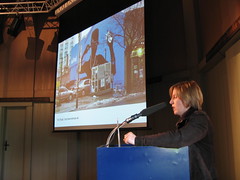
we-make-money-not-art link: waisvisz
read regine's notes from michel waisvisz's keynote here.
sound as a frame to a landscape
we make assumption of iPod bubble - isolation of headphones
how to come together to molecules?
public sphere - the feeling of connectidness
movement as mediation
generating meaning
Landscape
Romantic era:
Manifest destiny - controlled landscape
intoxicating landscape
fear of solitude/desire for individualism
paradox like paradox of the submlime
Post industrial landscape - fear, anxiety
before: VR - escape
cyborg body as a figure in the landscape
what do we look like?
We become the material of mobile ad-hoc networks
place as 1st person experience - phenomelogical
hertzian - abstract w/ respect to the objectiveness of visual
Yoho - memorial - to what? nonverbal?
Drift - soundspace moves w/ the tide - moving target - verbal
danger -
remote landscapes
Core Sample - Spectacle Island
conecting landscape to ICA indoors
Where is the music in all this?
Sound is the native modality of these landscapes
Target and target seeker
where does space go?
sharing - illusion of personal expression - is it fragmented
consumerism?
question off the shelf tech - they may not be as liberating as we think.
So where is mobile music in all this? I will posit an extreme to make my point.
Sound. The collective and all encompassing modality of the sonic reflects more the cultural moment in which temporality and event exceed the enlightenment focus on abstract point, rational object, and space as a void or container.
Duration becomes operative as does itinerary. The target, not the point, is the governing principle of the itinerary. We, as mobile subjects, are both the targets and the target-seekers. How then can we short circuit the logic of the target? How especially when the technology is deeply inscribed with this agenda both ideologically and functionally? How do we move from being cast as consumer, surveilled subject, or enemy toward the image of the mobile listener, creator and participant in the public sphere?
As a temporal condition, the mobile network is more landscape than architecture. Landscape is fundamentally changing and of a scale that extends from the bowels of urban infrastructure to the most remote landscapes captured only by the cameras and radio transmissions of space explorers. This landscape is more differentiation and texture, than form and tectonics. More becoming than being. As scale is radically telescoped from micro to macro and back again with no fixed index or reference, the contemporary mobile network landscape becomes more ratio than proportion (A. Picon).
So sound (and music), rather than the visual, become the modality most intrinsic to the nature of the mobile network landscape. This is a world of secondary orality – a field of electromagnetic waves that are invisible to the eye, but all encompassing in their ability to penetrate physical boundaries of architecture and the body, and fixed infrastructure, surrounding us at all scales.
In the future we will come to rely more and more on the model of ad hoc mobile networks that blur the wireless and wired fabric of communications networks. We will increasingly become the physical network as much as the social fabric from which networks emerge in the first place. As mobile nodes, moving in multiple spaces and times to form elastic connections, we come to define network as an event condition – a continuous unfolding of potentials. If we look at things in this light today we are immediately confronted with the question "Where are we? Who is and is not represented in the mobile network? Where do we go…and not go, and how does this begin to frame and limit the extent of the mobile network we love to imagine as a productively chaotic infinitude? How do we interact with one another in these spaces? Do we take time to reflect critically on the modes of interaction and communication that are being lost – and when we do, do we act on these insights – can we?
Yesterday this neighborhood was filled with the sound of a public outdoor concert. Indoors my acoustic landscape shifted from Buddy Holly to Roy Orbison to Johnny Cash – a classic 1950s juke box pulsing with the last selection made by a stranger. Perhaps neither of these environments reflected my personal musical preference, but the message was in the medium, not the content. The act of social gathering, individuals suspended in the connective tissue of public live performance – (a mobile, location based network technology) - offered as a free concert was perhaps more meaningful than the actual sounds we were hearing. Where does this space go when we adopt the personalized space of the portable music player or gps-equipped PDA, offering an interface to the city that is usually privately auditioned, even if collectively authored? Even in the context of music sharing, we need to ask ourselves if what we are sharing is the illusion of personal expression and individual style - or if we are merely conforming to a system of social interaction and exchange marked by fragmented consumerism and niche markets. In this moment of dual movement between global homogenization and expanded cosmopolitanism, what necessary role is played by compromise and negotiation of that which is other or outside the comfort zone of our cohort? As cultural producers, critics and consumers – as citizens - we have an obligation to question "off the shelf" technologies that appear as "natural" or "liberating". If we brush against the grain of mobile media forms, what might we discover as the underside of this condition and how will we respond?
Teri Rueb